Search Artists
 Search Disciplines
 Search
Places
Search
Places
In November 2025, DutchCulture | TransArtists and IGBK, together with a consortium of regional partners, organized a two-day meeting for residency operators, artists, and art organizers to share transregional contexts and interests in cross-border cultural cooperation.
The gathering also included a field trip in cooperation with the Borderland Residencies program and a joint panel at the Reading the Region conference at Kunsthaus NRW in Kornelimünster, hosted by the trinational network Very Contemporary.
This report, conducted by Christine Heemsoth of IGBK, summarizes the individual contributions and round tables on both days.
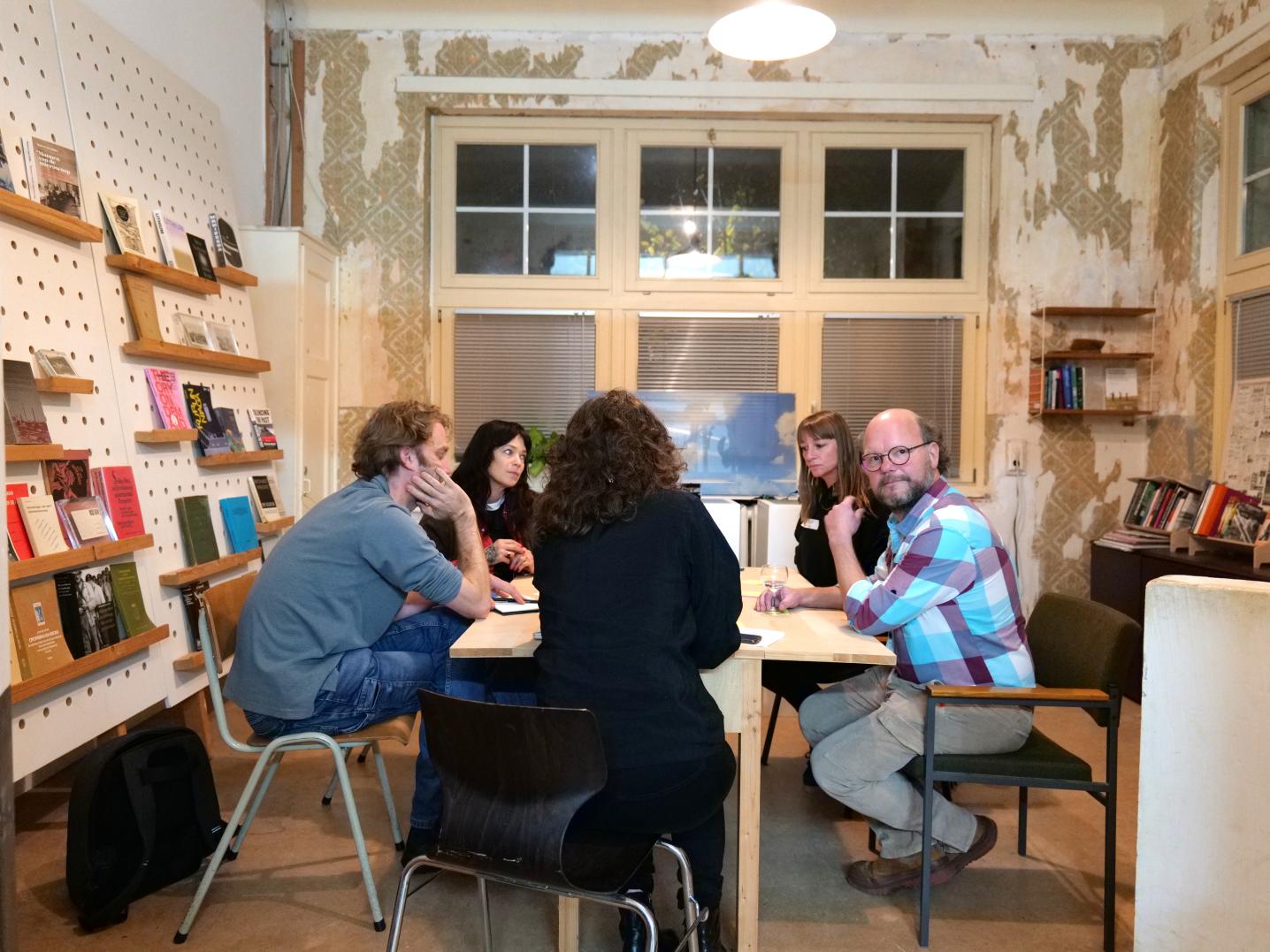
DAY 1, 13 November, Greylight Projects
Keynote 1: Constraining and Enabling – How Borders Shape Realities and Imaginations
Norbert Cyrus, Viadrina Center B/ORDERS IN MOTION, Frankfurt/Oder
The Viadrina Centre B/ORDERS IN MOTION is an institution of the European University Viadrina Frankfurt/Oder. Its research focuses on borders and border demarcations that aim to establish or maintain order and that exist on maps or as a sorting structure in people's minds. The idea that borders are dynamic is central to the work of the Centre. In his keynote speech, Nobert Cyrus expressed that the arts offer opportunities to illustrate and make visible that borders are not set in stone, but can also be conceived and understood differently. Borders are not only barriers; they also offer opportunities for access, whereby 'Durchlässigkeit' (permeability) is constantly being renegotiated.
Borders arise, disappear and reappear – on paper and in people's minds. Art is not based solely on knowledge or the rational exchange of information, but appeals to the senses. It becomes relevant when it disrupts social routines, when it touches on people's ways of thinking and behaving in relation to established meanings in social contexts. Based on the idea that all small parts of a system are interconnected and that adding even a single small part can change the entire system, art can enable (new) horizontal connections. Cross-border cooperation and residency programmes in particular can help to reinterpret borders. At the same time, we must ask ourselves how cross-border work can take place without simultaneously reinforcing the idea of borders. How can openness be created and maintained? What does a healthy border look like?
Keynote 2: Borderland Residencies
Nathalie Schulz, Kulturraum Niederrhein e.V.
Joep Vossebeld, Odapark Venray
The second keynote presentation focused on the Borderland Residencies program. Borderland Residencies is a network of artist residencies in the Euregio Rhine-Meuse region, which spans the borders of Germany, the Netherlands and Belgium. The region is home to a wide variety of residences with diverse structures and financial resources – from large museums to artist-run spaces, everything is represented, as Joep Vossebeld and Nathalie Schulz described. The Borderland Residencies program was launched in 2021 and provides financial support for scholarships and artistic co-productions, giving international artists the opportunity to spend three months as a resident in the region. The scholarship holders are extensively networked through the network in the region, which enables, for example, the presentation of works throughout the EuRegion. The network is growing steadily, with the commitment of the individual players remaining flexible and the number of participants varying from year to year. This shows that the more informal the approach, the higher the output, as Joep Vossebeld emphasised.
The actors in the network are not 'only' concerned with cross-border cooperation, but with working together for the EuRegion, a region that is seen and understood as a lively and artistically active cultural landscape. Borders are not viewed as barriers; rather, the participants engage with the history of the border area, with artistic research and networking at the forefront of the programme.
An important part of the work involves so called 'Field Trips'. Participants visit different locations in the region together and meet with various stakeholders. The focus is not on art, but rather on regional issues (agriculture, energy, protest movements) and processes of change, which are reflected upon together. The aim is to promote dialogue and acceptance of different points of view. Here, for example, open-cast mining in the border region offers a wide range of points of contact, which was vividly demonstrated to the participants of the 'AiR Cross Border Meeting DE-NL' on the second day of the meeting during a 'Field Trip'.
Borders are perceived above all when travelling within the region. On the one hand, they are easy to cross, but on the other hand, administrative issues and differing regulations repeatedly cause difficulties. Nathalie Schulz also found it interesting that the international guests who participated contributed their views on and experiences of borders. These vary greatly depending on the guests' origins, as well as the contexts in which the artists work and are based.
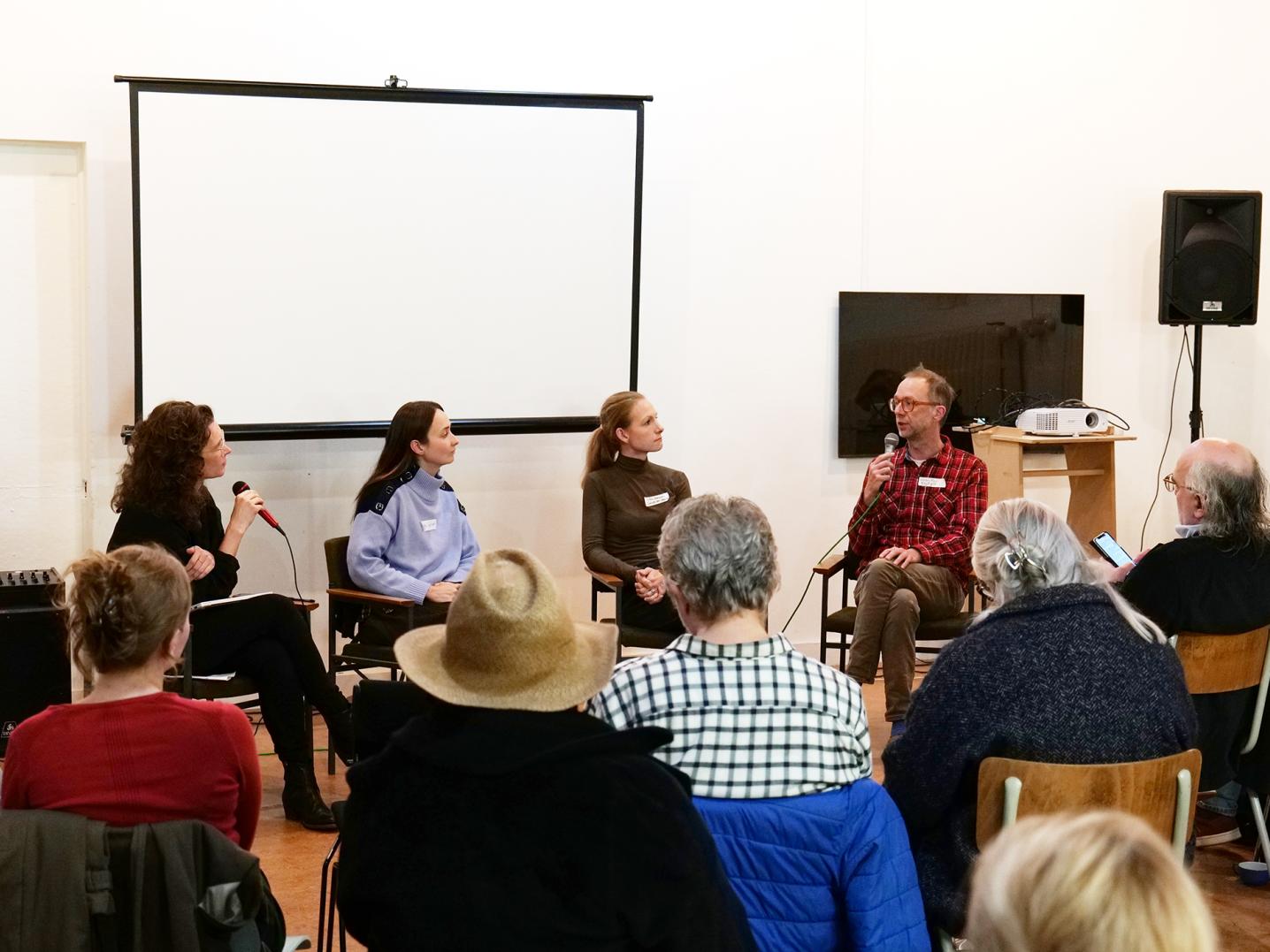
Panel
Brenda Guesnet, IKOB Museum of Contemporary Art Eupen
Julia Haarmann, Künstler*dorf Schöppingen
Wouter Huis, Greylight Projects, Heerlen
Moderator: Heidi Vogels, DutchCulture | TransArtists
The second round of discussions brought together Julia Haarmann from Künstler*dorf Schöppingen, Brenda Guesnet from the IKOB Museum of Contemporary Art in Eupen and Wouter Huis from Greylight Projects in Heerlen, with Heidi Vogels, DutchCulture|TransArtists, moderating the discussion.
Two questions were initially raised: What role play residences situated on the periphery, beyond the major cities? And what role do networks play in their daily work?
In the case of Künstler*dorf Schöppingen, it was the political decision in North Rhine-Westphalia in the 1980s to create a place for international exchange – away from the big cities, but with a supra-regional appeal, even beyond the borders. The fact that the place is located near the German-Dutch border does not play a decisive role in the Künstlerhaus's self-image. However, the landscape, the rural Münsterland region, and the history and former function of the farms that now house the Künstler*dorf have a significant influence on the work in Schöppingen and on perception: the invited artists interact with their surroundings. And it is in the tranquillity of the place that a landscape can possess a richness that broadens the view. From the perspective of the Künstler*dorf, it does not feel as if one is operating from the margins. In Brenda Guesnet's view, the fact that IKOB Museum of Contemporary Art is located on the periphery is always present. Eupen's remoteness from the major centres also offers advantages in that there is room for experimentation and there is no need to address the dominant themes that are frequently dealt with in cultural centres. In the border region, the local is also the international, as many actors and many perspectives come together and international guests reflect on local conditions.
Greylight Projects is located in Heerlen, the Netherlands, near the German and Belgian borders. Wouter Huis explained that, as hosts, they are particularly interested in artists who venture outside the studio to discover the local area: Heerlen, the borders, abandoned checkpoints, the open-cast mine. All of this offers scope for creativity, exciting stories and the unexpected. Here, too, it is more about calmly examining what is available than quickly responding to trends.
The three participants in the discussion consider networking to be central to their work in their respective locations. Greylight Projects specifically promotes networking and cooperation with a wide variety of actors in Heerlen, in the region and across borders – not least because Heerlen is quite small. Connecting with other organisations, artists and creative professionals can be much more productive than working exclusively within one's own immediate circle. Collaboration strengthens one's own programmes as well as those of others. In this way, residencies can complement each other. Brende Guesnet mentioned the very productive collaboration between Greylight Projects and IKOB: in supporting artists, both were able to provide valuable assistance by providing living, working and exhibition spaces. Nevertheless, collaboration is not always easy, Brende Guesnet noted. When everyone is preoccupied with their own concerns, networking often requires a great deal of additional energy.
Budget cuts often lead to more competition and the pursuit of individual interests. Julia Haarmann believes that cooperation is particularly important in times of budget cuts, as it enables mutual support. Solidarity can be seen as a form of resilience. It provides space for reflection on how things can be approached differently together. Networks at various levels play a major role in her work in Schöppingen: local networks, regional networks of cultural organisations, national networks, such as e.g. the ADIR Arbeitskreis Deutscher Internationaler Residenzprogramme (Working Group of German International Residency Programmes), and international networks such as ResArtis. Such networks are knowledge hubs and forums for the exchange of experiences and good practice.
Brenda Guesnet raised the question of who the audience is for cross-border collaborations such as the Borderland Residencies programme. The programme is primarily aimed at participating artists and organisations, but it may be of limited appeal to audiences in the region and local funding institutions, partly because people prefer local cultural offerings. How can process-oriented residency programmes, which follow a different logic than exhibition venues, for example, be communicated to an audience? How can a mindset that values cross-border collaborations be promoted?
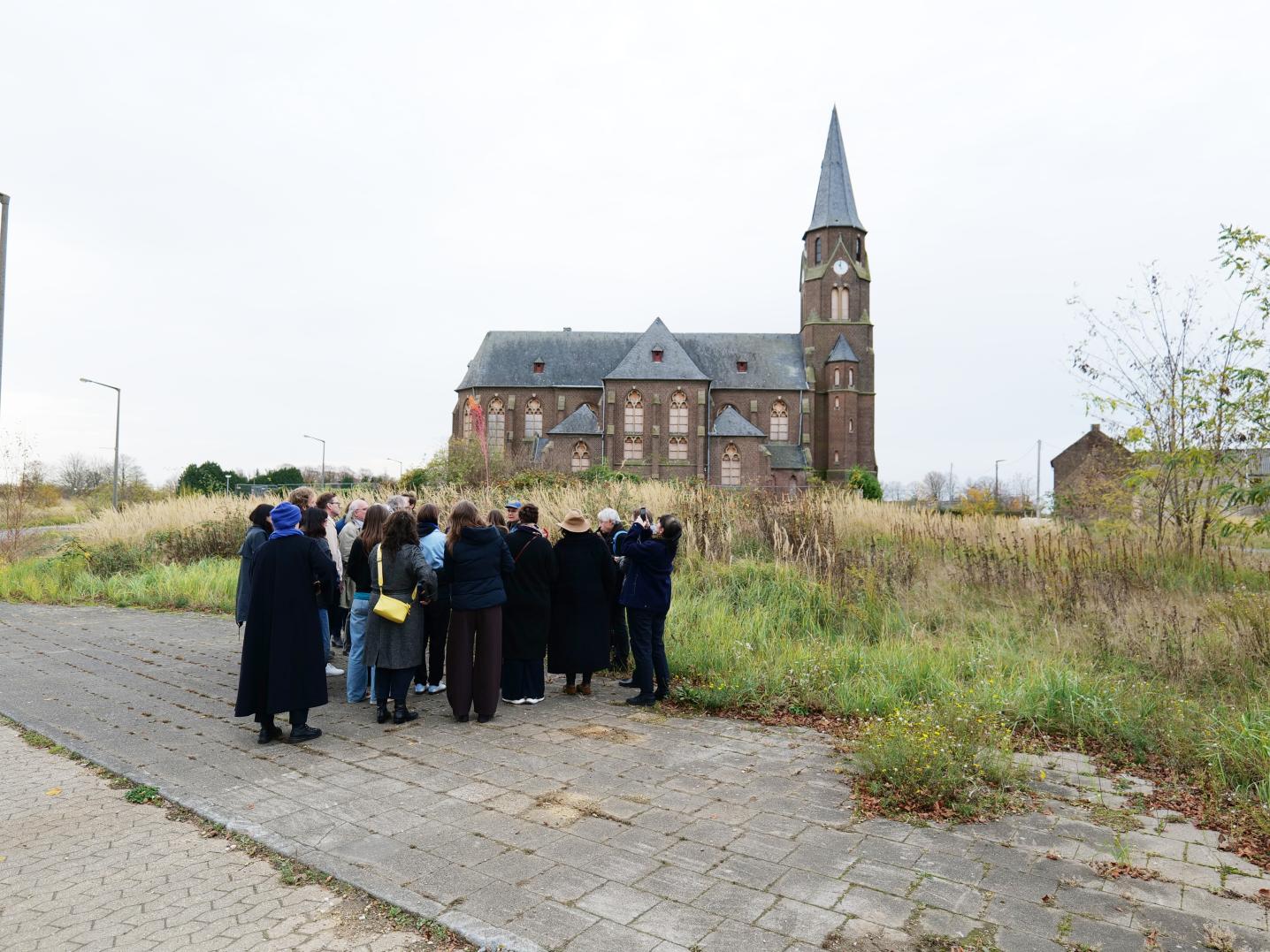
DAY 2, 14 November, Field Trip and symposium at Kunsthaus NRW, Kornelimünster
Field Trip: Art and Dilemma
Jörg Meyer zu Altenschildesche, Zweckverband Landfolge Garzweiler
Silke Schatz, Artist
Joep Vossebeld, Odapark Venray
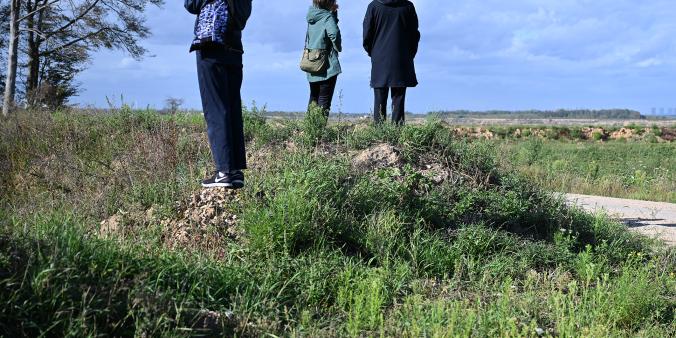
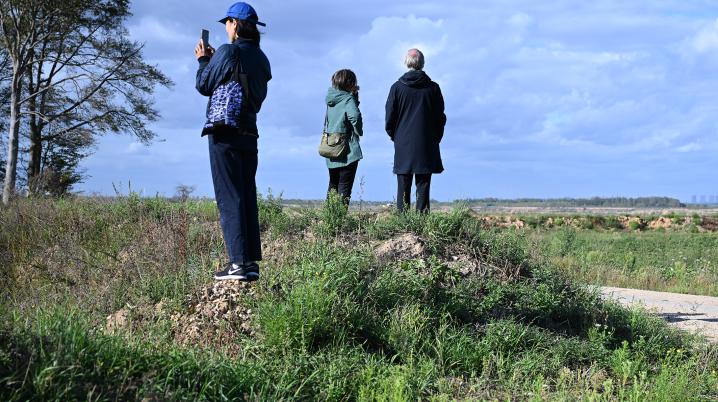
Comparable to the 'Field Trips' organized as part of the Borderland Residency program, the second day of the 'AiR Cross Border Meeting DE-NL' began with an excursion to the Hambach and Garzweiler open-cast lignite mining areas. To meet growing energy demands, huge holes have been dug into the landscape, and tens of thousands of residents in the region have had to make way for open-cast mining in recent decades. In keeping with the spirit of the 'Field Trips' – exploring local conditions and accepting different points of view on the same issue – participants had the opportunity to meet various stakeholders in the region.
In Manheim, one of the last villages currently being demolished, artist Silke Schatz provided insights into her work on site: her long-term project 'Manheim calling' is a multi-year documentation of the place disappearing from the map. Among other things, the artist identifies plants that are reclaiming the site after the people have left (see ‚Vanishing point‘). Silke Schatz also arranged a meeting with activists near the Hambach Forest and reflected on how art and activism interact in their respective fields.
The tour then continued to the village of Keyenberg on the edge of the Garzweiler open-cast mine. The lignite plan of the state of North Rhine-Westphalia envisages the creation of a lake after the end of open-cast mining. The lake is to be filled with groundwater and water from the Rhine and, in a few decades, will be one of the largest lakes in North Rhine-Westphalia. This is part of the recultivation process being carried out by mining company RWE Power AG – a project that will take decades to complete, with the consequences for nature and the environment not yet clear at this stage.
The village of Keyenberg was recently saved from complete demolition by a political decision, but around 80% of its inhabitants have already moved away. Jörg Meyer zu Altenschildesche from the Zweckverband Garzweiler Landfolge provided insights into the plans for the region, including how the 'ghost village' of Keyenberg is to be brought back to life and remodelled into an attractive residential location by the lake.
Symposium: Very Contemporary: Reading the Region
At the invitation of Kunsthaus NRW and the Very Contemporary network, a symposium entitled Very Contemporary: Reading the Region took place on the afternoon of 14 November at Kunsthaus NRW in Kornelimünster.
The event brought together artists, institutions and experts to discuss the conditions of art production in the Meuse-Rhine region, regional and cross-border cooperation, and the challenges and opportunities facing border regions in Europe. What challenges do artists and supporters face today? Which projects are particularly important? Which programmes have been and continue to be successful? These and other questions were addressed in the presentations and contributions.
Very Contemporary is a network of contemporary art and cultural venues in the Euregio Meuse-Rhine. Its sphere of activity is the border region between Belgium, the Netherlands and Germany.
Marcel Schuhmacher identified an important task for local players in the art scene: to see the Euregio as more than just a tourist destination, so that it can remain 'very contemporary' in a few years' time.
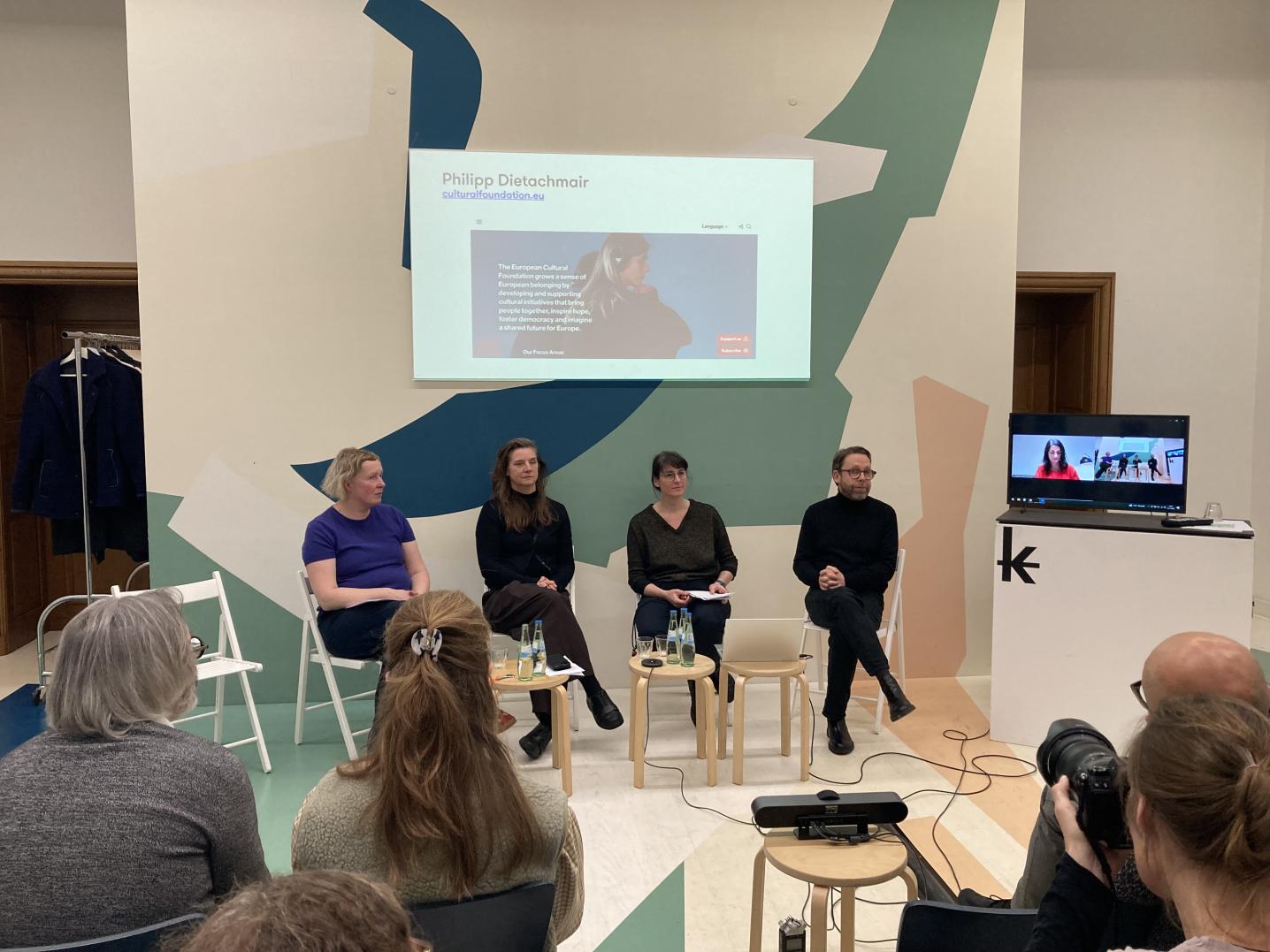
Panel: European Contexts
Philipp Dietachmair, European Cultural Foundation
Natalie Giorgadze, Culture Action Europe
Lene ter Haar, Cultural Attaché at the Consulate General of the Kingdom of the Netherlands in Düsseldorf
Christine Heemsoth, IGBK/touring artists, Mobility Info Points of On the Move
Moderated by Constanze Brockmann, IGBK
The final panel of the day as part of 'Very Contemporary: Reading the Region' on the topic of 'European Contexts' was convened by the IGBK and DutchCulture|TransArtists.
Lene ter Haar, Cultural Attaché at the Consulate General of the United Kingdom in the Netherlands, answered the question of how to support a vibrant cultural sector in the Meuse-Rhine region by saying that funding instruments are needed to support small and medium-sized cultural actors. Special structures are also necessary in such a region: networks and platforms that bundle activities and jointly represent their interests have proven to be extremely helpful.
Christine Heemsoth, editor at touring artists, presented Mobility Information Points as a helpful tool for artists and creative professionals in the region that work across borders. The MIPs provide information and advice on administrative issues relating to international work for artists and cultural actors. Topics covered include entry/residence, employment/contracts, tax, social security, etc., as well as questions regarding funding opportunities for cross-border projects. touring artists, the MIP in Germany, provides advice on mobility to and from Germany; in the Netherlands, the MIP is based at DutchCulture, and in Belgium, Cultuurloket represents the MIP for Belgium.
Natalie Giorgadze, Executive Director of Culture Action Europe, looked at EU cultural policy instruments that also have an impact in border regions. CAE has a good overview of regional cultural scenes and notes that border regions in particular are often places for experimentation – this must also be reflected in future EU programmes to promote the sector so that space for experimentation can continue to be guaranteed. The European Commission recently presented the Culture Compass, which defines cultural policy for the coming years. The promotion of cross-border cooperation is firmly anchored in this document. Negotiations are also currently underway on the future Agora EU programme, which will merge the Creative Europe and Citizens, Equality, Rights and Values programmes.
Philipp Dietachmair, Head of Programmes at the European Cultural Foundation, explained that it has been apparent for some time that cultural initiatives outside the major cities receive too little attention, despite major challenges such as an increasingly anti-democratic and anti-European environment. As a counterpoint, the programme 'LOKAL für Kultur und Engagement' (LOKAL for Culture and Engagement) was set up in cooperation with the Kulturstiftung des Bundes (German Federal Cultural Foundation) and the Bundeszentrale für politische Bildung (Federal Agency for Civic Education). It is aimed at artistic and cultural initiatives in communities with fewer than 100,000 inhabitants that work together with local social actors such as schools or fire brigades. The creation of local solidarity networks, which are invaluable for strengthening cooperation within a region and even across borders, is seen as crucial.
Speakers in order of the program
Dr. Norbert Cyrus
Norbert Cyrus is a trained social and cultural anthropologist and received a PhD from Osnabrück University with a dissertation on "Labour Migration and Social Work." He is engaged in migration research since the mid 1990s with a focus on the governance of labour migration and the social rights of migrant workers, including migrants in an irregular situation. Since 2015, he works as a research associate at the Viadrina Center B/ORDERS IN MOTION at European University Frankfurt (Oder), with a particular focus on the analysis of the complexity of state borders. Currently, he is engaged as scientific advisor and evaluator in the EU-funded INTERREG-project "Aufbau und Umsetzung von Grenzinformationspunkten" - Establishing and Implementing Border Information Points, a joint project of Polish and German actors in the border region. His publishing record is broad. Three publications may be of particular interest for you: Insights from Complexity Thinking for Border Studies, and in German only: Good advised across the border and "From bounded seeing to seeing boundaries - the thematization of state borders in social sciences and fine arts, a paper that was prepared as contribution to the IGBK event Transitions/Neighbourhood (Übergänge/Nachbarschaft).
Julia Haarmann
Julia Haarmann has been managing director of the Stiftung Künstler*dorf Schöppingen since January 2021. Künstler*dorf is located in the rural Münsterland area in North Rhine-Westphalia and awards around 40 fellowships each year in the fields of visual art, literature and composition.
From 2010 to 2020, Julia Haarmann initiated and directed the artist residency CAT Cologne (Community Art Team) in Cologne. Her curatorial focus here was on social practices that incorporate its environment as resource, medium, and addressee at the same time. For more than ten years she worked for international galleries, in particular König, Berlin and Galerie Buchholz, Cologne. Julia Haarmann studied art history, sociology and English at the Albert-Ludwigs-Universität Freiburg, the Sorbonne Paris and the Humboldt-Universität Berlin.
Brenda Guesnet
Brenda Guesnet (b. 1993, Bad Soden am Taunus, Germany) is a curator with an institutional and an independent practice. She is based in Brussels, Belgium. Since 2021, she is working as Curator and Deputy Director of IKOB – Museum für Zeitgenössiche Kunst in Eupen, in the German-speaking community of Belgium. At IKOB, she has curated solo exhibitions by Arthur Cordier, CMMC, Kristina Benjocki, Marcin Dudek, Veronika Eberhart, Francis Feidler, Helen Anna Flanagan, Alexandra Tretter, and Léon Wuidar among others, as well as the group exhibitions “Eat the Rainbow”, “All our Yesterdays”, and the “IKOB – Feminist Art Prize”. She also curates and coordinates the museum’s public, educational and residency programmes and produces the podcast ‘apropos’. Brenda Guesnet has been realising independent curatorial projects since 2015. She is co-founder of celador, an independent space in Brussels. She previously worked in the Artist Liaison department at White Cube (2017-2020) and as a curatorial assistant at Tenderpixel Gallery (2016-17), both in London, after completing an MFA in Curating at Goldsmiths, University of London (2015-17).
Dr. Susanne Ristow
The head of program at LaB K Dr. Susanne Ristow is an artist, art educator and media scientist in Düsseldorf. She completed her doctorate in 2019 at Heinrich Heine University Düsseldorf on “Virus as Medium” and published the revised version of her doctoral thesis under the title “Kulturvirologie. Das Prinzip Virus von Moderne bis Digitalära” (De Gruyter, Berlin, 2021). She is a volunteer in artists’ associations in NRW and until a few months ago worked as a postdoc at the University of Frederick II of Naples with Federica Weblearning. She sees her central tasks at LaB K in dialogue with the art scene and in linking regional with national and international experiences of artistic self-organization.
Christine Heemsoth
Christine Heemsoth works for the Internationale Gesellschaft der Bildenden Künste/IGBK and is part of the touring artists project team. touring artists is the German Mobility Information Point (MIP) and provides artists and creatives working internationally with information and advice on administrative issues from a German perspective. She also works for the Bundesverband Bildender Künstlerinnen und Künstler/BBK (Federal Association of Visual Artists), for which she is a member of the editorial team of its magazine. She studied Cultural Studies and Theatre Science at the University of Leipzig, and has worked in the visual arts sector for over 20 years, focusing on international exchange.
Natalie Giorgadze
Natalie Giorgadze is General Director at Culture Action Europe, the major European Network of cultural organizations. Natalie is responsible for designing and implementing the network's strategy. Her focus lies in community development, knowledge creation and transfer, as well as strategic communications. Additionally, she oversees the comprehensive planning of the organization's projects, activities, and teams. Natalie's background in NGOs includes roles within human rights and environmental networks. She is trained as a journalist and social psychologist and holds a postgraduate degree in Cultures and Development Studies from the Catholic University of Leuven.
Philipp Dietachmair
Philipp Dietachmair is a cultural practitioner with over twenty years of experience in international cultural cooperation. He began his career in Sarajevo, supporting post-war initiatives to rebuild student cultural life and higher education in Bosnia and Herzegovina. He is currently Head of Programmes at the European Cultural Foundation in Amsterdam, where he previously led arts and culture programmes across Central and Eastern Europe, the former Yugoslavia, Turkey, Ukraine, Belarus, Moldova, the Middle East, and North Africa.
He is co-founder of the Tandem collaboration programmes, which have connected hundreds of cultural and community organisations in more than forty countries. He also co-designed the Culture of Solidarity Fund, launched during the COVID-19 crisis and now a key European philanthropic platform supporting cultural solidarity actions, including in Ukraine.
His recent work focuses on socially engaged arts and cultural initiatives in non-metropolitan areas. He has contributed to publications and research on culture’s role in civil society and on more sustainable models of cultural mobility.
The AiR Cross Border Meeting was initiated by DutchCulture|TransArtists (Amsterdam) and the Internationale Gesellschaft der Bildenden Künste (IGBK) (Berlin), organized in partnership with Greylight Projects (Heerlen), Landesbüro für Bildende Kunst NRW, and Kunsthaus NRW (Kornelimünster), in collaboration with Borderland Residencies Program, with the support of Pictoright Fonds and Goethe Institute Amsterdam.