
 Search Artists
 Search Disciplines
 Search
Places
Search
Places
Visiting Madrid – art, community and encounters
After our first encounter in Hamburg, the Residencies Research Group came together again at Casa de Velázquez, living and working side by side as we explored the city’s rich residency landscape.
Our second residency as part of the CAT project took place in September 2024 at MIAS – Madrid Institute for Advanced Studies at Casa de Velázquez. During our stay we continued our exploration into different models of art residencies by focusing on the unique ecology of the Madrid art scene.
With this in mind, we selected a series of residencies that operate across both institutional and grassroots frameworks. These case studies allowed us to reflect on how different organizational structures support, host, and accompany artistic practice. Our visits included Gri Gri Projects, Matadero Madrid, La Casa Encendida, and the residency space where we were based, Casa de Velázquez itself.
Casa de Velázquez: a house of many doors
Located at the edge of Madrid’s University City, Casa de Velázquez is an institution dedicated to artistic creation and academic research, fostering exchange between Spain and France. Founded in 1928, it houses both the Académie de France à Madrid (for artists) and the École des Hautes Études Hispaniques et Ibériques (for researchers). The space provides a unique environment for dialogue between the arts and the humanities, offering residents long-term support, workshops, and a rich interdisciplinary community.
Funded by the ministry for science and research, the Casa is a French enclave in the middle of a suburban university campus, the highway pressing against its gated perimeter, which encloses a neoclassical villa, formal gardens, staff living quarters, and a cluster of studio apartments around the swimming pool. Designed for serious independent work, it hosts artists from different disciplines for eleven month stays with a salary and production budget, as well as scholars who come to use the library, focused on the study of Spanish culture and history. Our team lived in the short-stay dormitory, in large, pristine single rooms arranged down hallways lined with paintings. Returning to your room each day, you could be sidetracked by this domestic art gallery, making friends with a sculpture or photograph produced by some former resident.
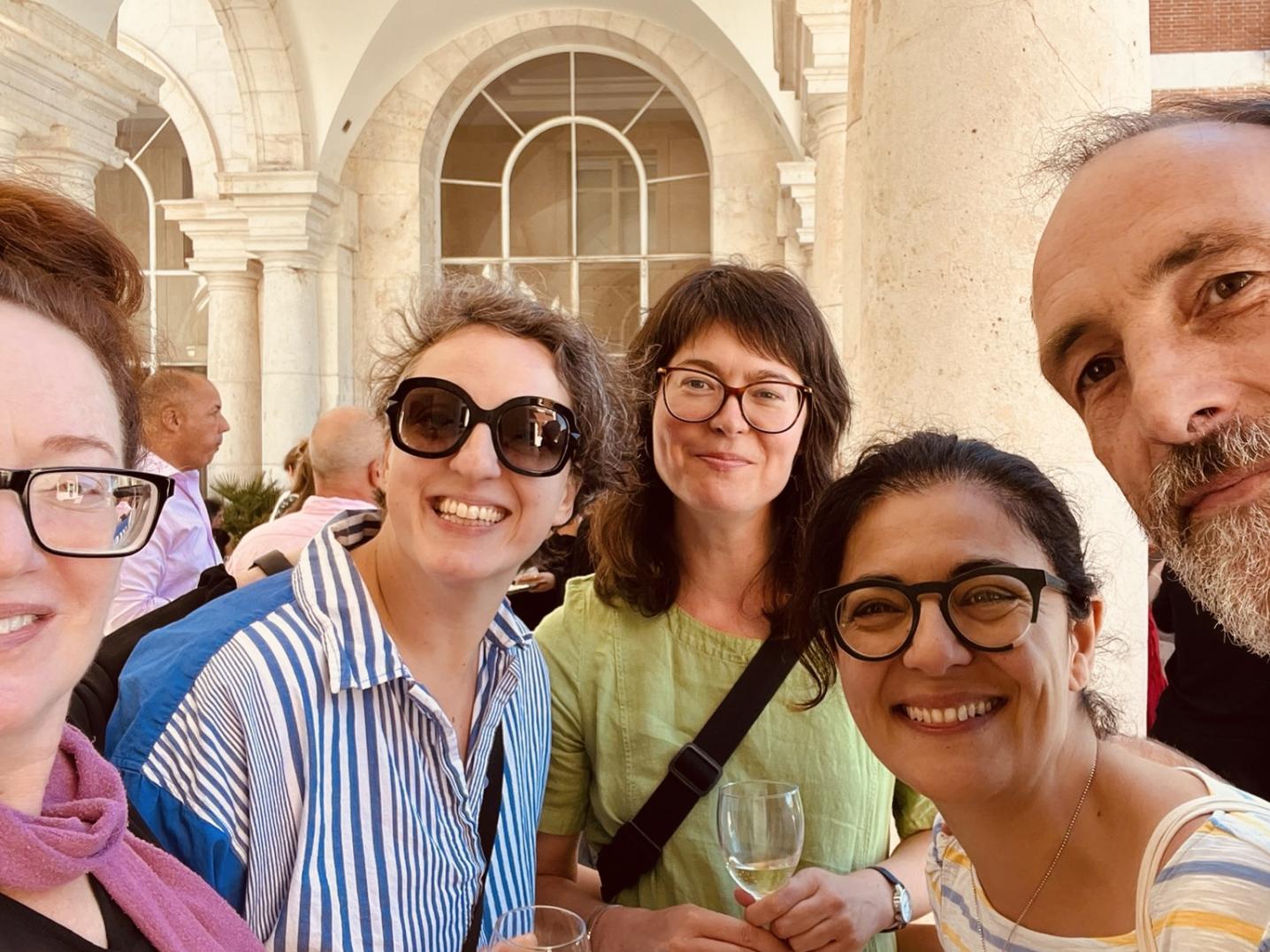
We arrived in a week of two institutional openings at Casa de Velázquez: the beginning of the annual artist residency and the installation of an exhibition in the Casa’s ground-floor gallery about the flamenco performer Miguel de Molina. It had the feeling of the first week of school or summer camp–tentative, unsure of the rules and norms, who’s who, where to get a drink or groceries. The kitchen was a break with the formality of galleries and silent halls, a space where conversations bloomed between artists, researchers, and staff.
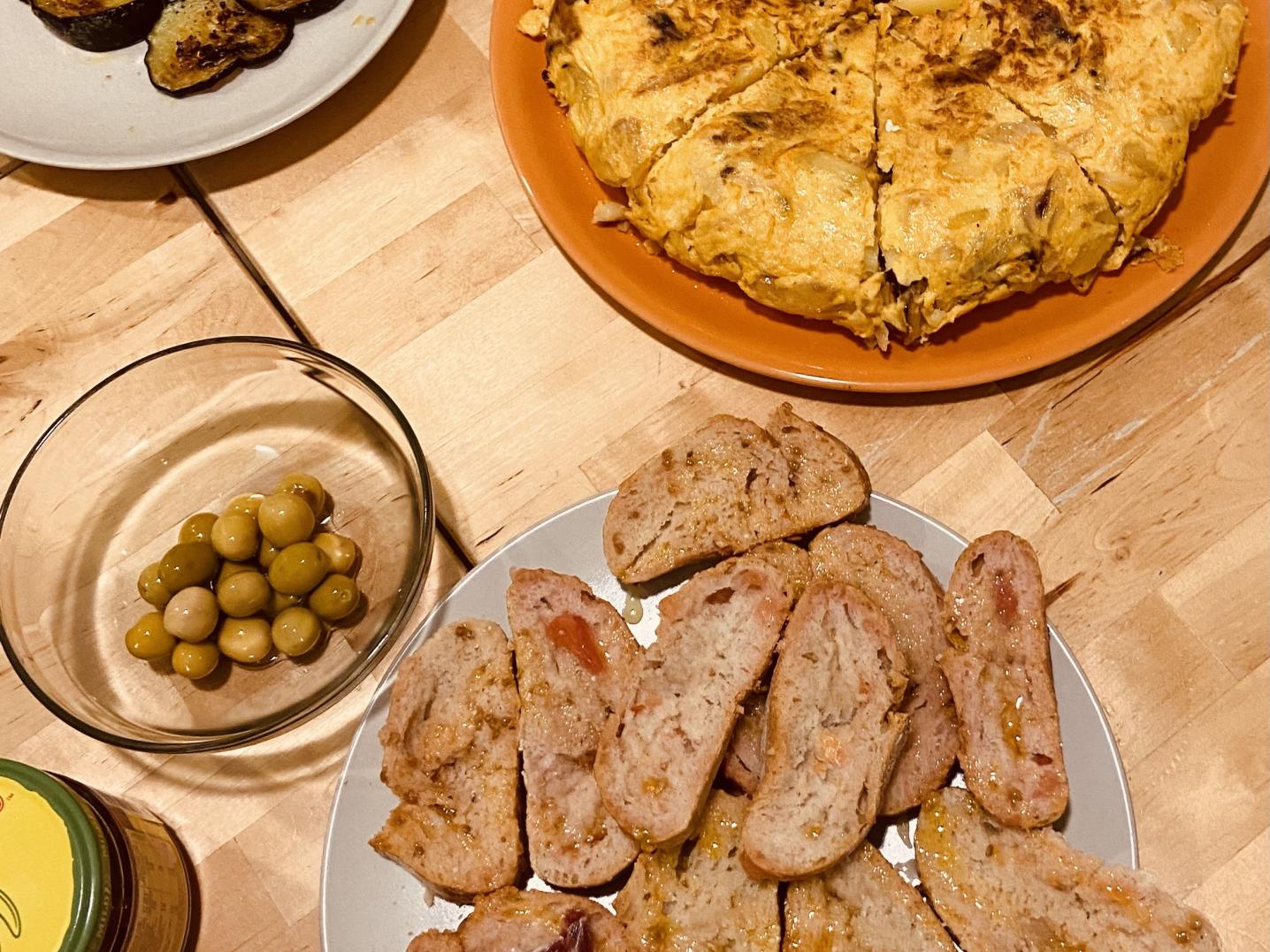
Indeed, the communal heart of Casa Velázquez is the kitchen, tucked away behind a few doors off the central elevator bank. With three refrigerators, shelves full of other people’s provisions, and big round dining table, it was a space of laughter, little notes (“please eat the peaches!”) and informal negotiation–figuring out where fellow dishwashers and pasta boilers were coming from and what they were there for, but first, which language you had in common (French the default, Spanish second, English a necessary third). One night, Pau made tortilla for our team and whoever else came in. We talked about funny Catalan Christmas traditions, but also the weirdness of studying residencies via a residency in a residency.
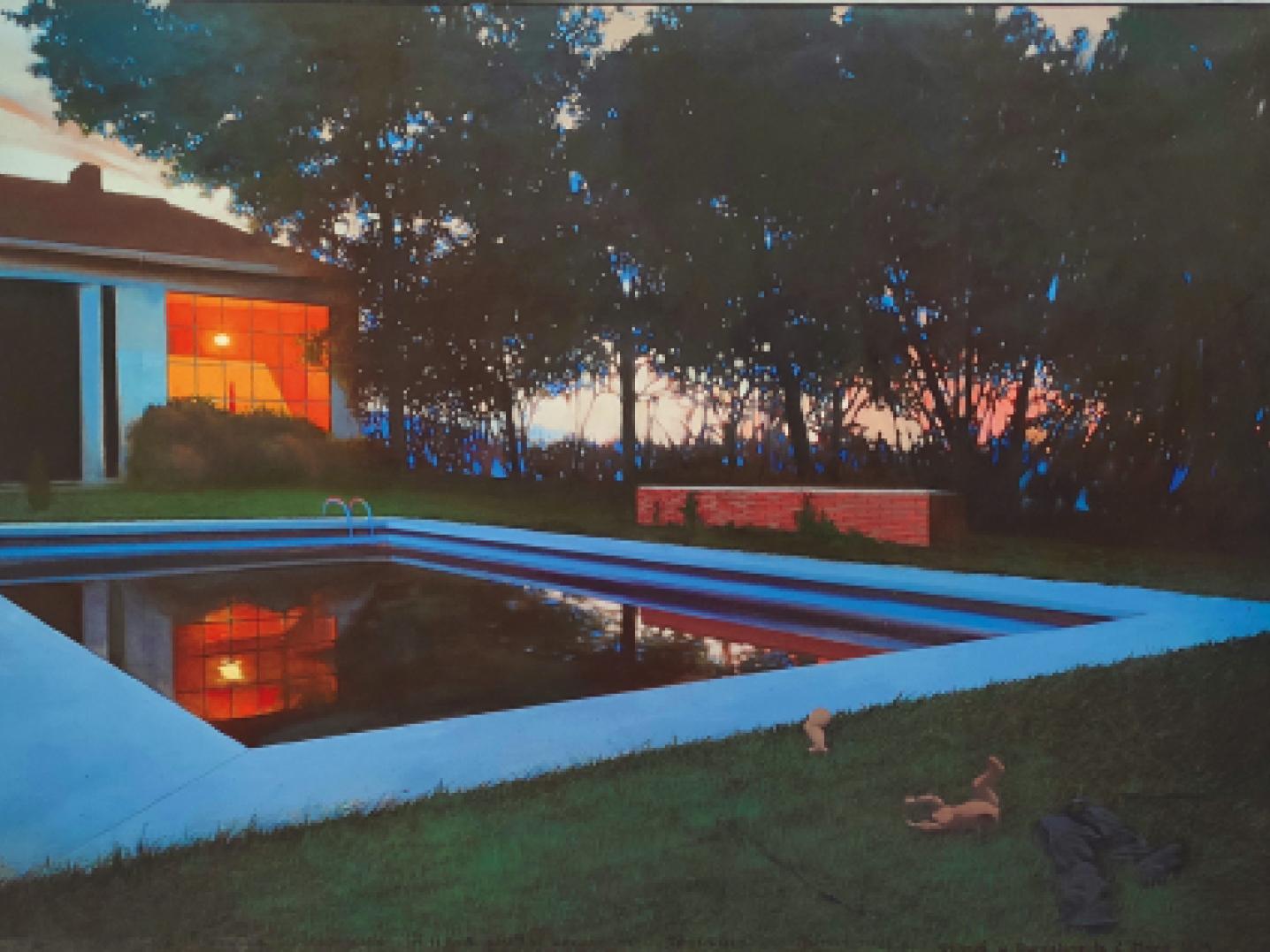
In this ample but institutional setting, our thoughts turned to history: what constellations of wealth, power, and ideas produced this odd phenomenon, a French academy along a Spanish highway? Recounted by our host Gwladys Bernard, a lecturer in ancient history at University of Paris 8, the story is endlessly fascinating, weaving together ambitions for power and peace in Europe after the First World War; a King’s unrealized vision of Madrid as the new Rome (there was a plan for academies from every nation, but only the French one materialized); total destruction during the Civil War and rebuilding during the 1950s; and the tribulations of French radicals in the late 1960s, caught up in the politics of the Franco dictatorship. In Gwladys’s office, the painting Madrid 73, La piscine de la Casa de Velázquez au crépuscule by Jacques Damville tells us an intriguing story of censorship, secrecy and death. A detailed account can be read in Gwladys Bernard and Jacques Damville’s article, "The object of the crime: an interview with Jacques Damville, visual artist, former member of the French Academy in Madrid-Casa de Velázquez (1972-1974)".
Outside the Casa: visiting Matadero, La Casa Encendida, and Gri Gri Projects.
After a couple of days of intense work at the Casa, we crossed the city, curious to encounter other communities and approaches. While the Casa represents a long-standing, state-supported model, Madrid hosts residencies operating at different scales and with different priorities. To explore this wider landscape, we visited Matadero Madrid, La Casa Encendida, and Gri Gri Projects.
Matadero Madrid. Once a municipal slaughterhouse, Matadero Madrid is now one of the city’s leading cultural centers. Managed by the Madrid City Council, it came across as a space for contemporary creation in the wider sense, spanning visual arts, performance, design, music, film, and more. Here we met with Luisa Espino, Head of the Centre for Artistic Residencies (CRA), who introduced us to the program and toured us through the impressive studio spaces: a vast 2,000 m² ground-floor hall where mobile walls and modular structures allow the space to shift from intimate working zones to open workshop areas, expanding or contracting as needed by the residents. CRA supports artists through production grants, workspaces, and mentorship initiatives, and assigns its residency places via open calls across different programs that often run in parallel. During our visit, we noticed how the residency moves on an international level, building partnerships and collaborative projects, while remaining attentive to the local scene. At the time, CRA was working on “Sustainability is in the AiR (SAiR)” (2023–2025), a Creative Europe project on post-pandemic sustainability with residency partners in Athens and Prague. While new residents were expected to come in soon, one of the studios was occupied by AMECUM, a collective of mediators, educators, and cultural managers who were using their research residency to open their travelling mediation library, mediaTECA, to the public through a programme of activities.
La Casa Encendida: A home in the making
This was another major institutional space in the local scene. Active since December 2002 and supported by Fundación Montemadrid, a private foundation, it aims to bring together social engagement and contemporary artistic practices. Guided by the warm and energetic Pablo Berástegui, Director of La Casa Encendida, we walked through the expansive spaces of this historic building, constructed between 1911 and 1913, and originally serving as a charity pawnshop and a branch of the Madrid Savings Bank. We began on the ground floor, which hosts the exhibition spaces, and then moved through the three upper storeys, visiting artists’ studios and the open-access library and media library. The library in particular, freely available to anyone using the space, serves as an important intergenerational gathering point for the local neighbourhood. We also visited the courtyard, where a flurry of activity was underway for their annual performance festival, Ídem 2024, about to begin. Our visit ended on the rooftop terrace, where a beautiful garden and two newly renovated studios for music and performance rehearsals overlook the city.
As we moved through the building, we learned that La Casa Encendida had previously run an official art residency programme (2018–2022) to support performative, body-centred creation and research. With the arrival of the new director, the programme in its previous form is currently suspended, as the centre now focuses on new ways to support artists through its studio spaces and facilities, connecting this production more closely with its performance programme.
Gri Gri Projects: The place is its people
While Matadero and La Casa Encendida operate at a larger, more institutional scale, Gri Gri Projects brought a grass-roots perspective, grounded in small-scale, community-driven forms of artistic and social practice. Reaching their office meant travelling farther out, moving from monumental, historical buildings to ordinary residential streets in the working-class neighborhood of Vallecas. Their office occupied the ground floor of a housing block, with large windows and an open door that immediately signalled a sense of accessibility and welcome. Sitting at a table with one of the core members, architect David Pérez García, we quickly learnt about the particular origin of the organisation’s name: “grigris”, amulet-like objects, meant to re-enchant and protect common spaces. You can hear the founders telling this story here.
Among their many projects, a key example of their way of working is GRIGRI pixel, realized for their tenth anniversary. Structured as a program of residencies, public-workshops, and collaborative labs, the project brought together creatives, makers, designers and community-organizers from Europe (mainly Spain) and African cities, including Dakar, Bamako, Lomé, and Casablanca.
Visiting artists gathered with local neighbours and makers in Madrid to imagine and build new “grigris”, small protective devices meant to re-enchant everyday spaces. The process was lively and hands-on: days spent mapping stories in the streets, sketching around shared tables, and assembling objects in open workshops where passers-by could join in. The process itself, the making of these crafted artefacts, created temporary alliances and joyful exchanges, a circulating energy that linked distant contexts and people. Thus offering a way to reimagine “common life” in cities.
Back to the Casa: meeting Julia Ramírez Blanco and Ane Rodríguez Armendariz
As we moved between the Casa and the city, we invited two speakers whose research felt particularly meaningful for the themes we were working with: senior researcher Julia Ramírez Blanco and curator Ane Rodríguez Armendariz. Their insights helped us situate our questions within broader historical and institutional perspectives.
In her interdisciplinary work, Julia Ramírez Blanco connects art history, utopian studies, and activist movements. She has studied the political iconography of social movements, particularly British environmental direct action in the 1990s and Spain’s 15M movement (2011). Our discussion with Julia focused on her most recent book, “Amigos, trajes y comunas” (2023), an important reference for our research. Through a historical journey beginning in the wake of the French Revolution, she searches for the patterns that define nineteenth-century artistic brotherhoods as precursors of artistic collectivism, a perspective that resonated with our own questions about the role of friendships and artist collectives within residency contexts.
Ane Rodríguez Armendariz brought a different yet equally compelling perspective, grounded in a practice that lies at the intersection of curating and cultural management, what she calls “institutional practice.” Anne has worked to reformulate institutional models through her leadership roles at Matadero Madrid (as Director of Artistic Residencies, 2020–2023) and at Tabakalera in San Sebastián (Cultural Director, 2012–2019). In our conversation, she talked us through her latest research project, Matter(s) of Care, developed during her residency at the Real Academia de España in Rome (2023–2024) and inspired by ecofeminist thinker María Puig de la Bellacasa and her concept of “thinking with care” (Matters of Care, 2017). She spoke of residencies not only as structures of support but also as sites where conflict, asymmetry, and institutional tensions surface. “Many of the tensions arise from the direct clash between the institution’s hierarchical structure and the curatorial discourses that seek to make it a more inhabitable place,” she noted. Rather than reducing residencies to functional frameworks, her contribution was a reminder not to forget the relational, affective, and ethical dimensions that shape residency life.
Arrevoire, Madrid!
Our week in Madrid revealed that the ecosystem of art residencies is as much about relationships as it is about infrastructure. From the institutional corridors of Casa de Velázquez to the collaborative networks of Gri Gri Projects, each space offered a different answer to the same question: how can artists live and work together meaningfully?
These encounters invited us to rethink residencies not as isolated programs but as evolving communities—spaces where art, politics, and daily life intertwine, and where the act of “cooking together” might offer a model for reimagining both art and care.